
The economy could grow at 6-6.5 per cent this fiscal year (2019-20 or FY20), said Chief Economic Advisor Krishnamurthy Subramanian, revising his earlier estimate of 7 per cent in the Economic Survey. In an interaction with Arup Roychoudhury, he said supply-side measures, including corporation tax cuts, will boost consumption and demand, and non-tax revenue may make up for shortfall in tax revenues.

The consumer price index was estimated as being up 3.5 per cent in March from a year ago, the biggest increase in 15 years. On June 6, 2007, the European Central Bank raised its key interest rate from 3.75 pe cent to 4.00 per cent, the highest level in almost four years. In terms of economic freedom, old Europe still lags behind. The Heritage Foundation has the three largest economies, Germany, France, and Italy, ranked 19th, 45th, and 60th respectively in the world.
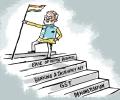
Three-quarters into the 10 years that Mr Modi had sought for transforming India, the 'output' numbers look impressive, but the key 'outcome' numbers don't show up much, if at all, observes T N Ninan.

Search is on for reliable indicators of underlying activity.
The economy is slated to grow by 6.3 per cent over the financial year 2004-05 and accelerate to 6.8 per cent in the next fiscal, credit rating agency ICRA said on Tuesday.

Analysts remain selective on cement stocks amid the likely government's capex push ahead of the scheduled general elections in May 2024. While UBS has initiated coverage on the Indian cement sector with an anti-consensus negative view and suggests investors sell select cement stocks on a rally, those at Nomura remain selectively bullish on the sector and prefer companies with large brownfield optionality and multi-region presence. In the near-term, UBS expects strong earnings of cement companies in the next two quarters to be driven by robust demand and margin tailwinds, but suggests any sharp uptick in stock prices could offer a good opportunity for booking profits in the related counters.

Concerned by GDP slowdown and unrealistic tax targets, the economists urged Finance Minister Nirmala Sitharaman to implement long-term structural steps like land and labour reforms. Warning against any off-Budget financing the economists said the government should prepare a statement of intent for its social, rural and welfare sector expenditure.

In rupee terms, India's market cap is currently about Rs 184 trillion - 90 per cent of the GDP of Rs 203 trillion for FY20 at current prices.

Fitch had last upgraded India's sovereign rating from BB+ to BBB- with a stable outlook on August 1, 2006.

Encouraged by improvement in corporate earnings and decent monsoon forecasts, Citigroup has raised its BSE Sensex target to 28,800 for the fiscal year ending March 2017.
Global growth, according to IMF, likely to be lower at 3.3%
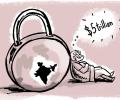
India decisively withstood global headwinds in 2023 and is likely to remain as the world's fastest-growing major economy on the back of growing demand, moderate inflation, stable interest rate regime and robust foreign exchange reserves. Despite widespread pessimism witnessed among the developed nations and the worsening geopolitical situation, India recorded a gross domestic product (GDP) expansion of 6.1 per cent in the March quarter. The growth moved up to 7.8 per cent in the June quarter and was 7.6 per cent in the September quarter. For the first six months of this fiscal, the growth was 7.7 per cent.

India lost fastest growing major economy tag to China in the March quarter with a GDP growth of 6.1%

N R Bhanumurthy, professor of economics at the National Institute of Public Finance and Policy, and the author of the series, presented in a report to the National Statistical Commission, explains to Abhishek Waghmare various aspects of the methodology.
Indian economy recorded a growth of 5.5 per cent in the first quarter of 2012-13.
The economy grew at 6.7 per cent in 2008-09, which is a sharp downward curve when compared to the 9 per cent or more growth that took place in the previous three years.

Market participants attribute the stability to the Reserve Bank of India's timely intervention in the foreign exchange market, both in terms of selling and buying dollars.
A World Bank reports says the country has shown signs of "some softening" that could slow down the pace of growth slightly in 2011.

'Vaccination is very important for an economy to start functioning properly.'

'It is becoming clear that we will no longer see declines in GDP growth for the next few quarters.'

Through this transaction, Amazon has managed to acquire around a 3.6 per cent stake in the Future group.

The six-member monetary policy committee voted 5:1 for the decision, with only Ravindra Dholakia voting for a 0.25 per cent reduction in rates.

Swiss brokerage Credit Suisse expects the economy to continue to show positive surprises and record up to 9 per cent growth in the next fiscal. For the current financial year too, the brokerage anticipates growth to be higher than the consensus forecast of 8.4-9.5 per cent, and printing in at around 10.5 per cent. As a policy, Credit Suisse does not provide absolute growth numbers in its forecast.

As COVID-19 infections spike in the country resulting in restrictions in various states and impacting the fragile recovery, many economists are expecting RBI to delay the policy normalisation move, which is expected in the February review. The country has reported a single-day rise of 58,097 new Covid-19 cases as of Wednesday morning--the highest in around 199 days -- of which 2,135 are Omicron cases and later in the day, the first confirmed Omicron-related death has also been reported. Maharashtra recorded the maximum number of 653 Omicron cases followed by Delhi at 464, Kerala 185, Rajasthan 174, Gujarat 154 and Tamil Nadu 121 cases, taking the total tally of cases to 3,50,18,358.

Tata Steel was the top loser in the Sensex pack, shedding 3.01 per cent, followed by M&M, Maruti, Asian Paints, PowerGrid, ITC and Axis Bank.
The government has given up the claim of record economic performance and laid itself open to the charge that rapid economic growth is not benefiting the common man.
CII on Thursday objected to any mandatory reservation for socially underprivileged in the private sector even as it forecast 8.3 per cent GDP growth target for this financial year.

The digital opportunity is not just tech opportunity, but an opportunity to reinvent client business model.

India's economy is moving towards a higher growth trajectory and is likely to grow at around 10 per cent in 2021-22, Economic Advisory Council to the Prime Minister (EAC-PM) chairman Bibek Debroy said on Wednesday. "I am confident that we are on a path towards a higher growth trajectory, higher poverty reduction, higher employment, and a prosperous, more developed and better governed India. "I think it is, more or less, agreed that the real rate of growth this year (FY2022) is going to be around 10 per cent," Debroy said at an SBI event. At the beginning of FY2021-22, the forecasts for real growth were in the 8.5-12.5 per cent range, he noted.

The economy faces more downside risks now as economic disruptions arising from the second wave are likely to stabilise only from July, warned the Swiss brokerage USB Securities. Last month, the brokerage had cut its GDP forecast by 150 bps to 10 per cent for FY22, which though is much higher than the consensus projections by others with some pegging it at as low as 8 per cent. Though adverse impacts on sequential growth is less severe than in the June 2020 quarter when it plunged by 23.9 per cent, as lockdowns are more targeted and localised and households and businesses have adjusted to the new normal now, still, it is increasingly possible that normalcy returns only by July as against our baseline assumption of June.

Thirteen companies have joined the Rs 1-trillion-plus market capitalisation club this year, so far. This even as the benchmark Sensex has gained less than 3 per cent on a year-to-date basis, underscoring the bullish undercurrent in the broader market. The trend shows a harsh second wave of Covid-19, subsequent lockdowns, and hit to the economic activity has made little dent into India Inc or shareholders' wealth. At the start of the year, there were 29 companies with a market value of more than Rs 1 trillion.

'We are looking at the Budget with the hope that it will address all issues even at the cost of exceeding the fiscal deficit target.'
Anjalika Bardalai, senior economist and editor at Economist Intelligence Unit says fiscal deficit is the biggest downside risk to India's growth story.

FY16 GDP growth was seen at 7.5%, against 8.1-8.5% earlier.

In the Sensex pack, HDFC, ONGC, Bharti Airtel, Titan, Asian Paints, Mahindra and Mahindra and TCS were the prominent gainers. On the other hand, ICICI Bank, IndusInd Bank, NTPC, UltraTech Cement, Tech Mahindra and SBI were among the major laggards. On the other hand, HCL Tech, Tech Mahindra, HUL, Bharti Airtel and ICICI Bank were trading in the red.
While the jury's still out on whether US President Barack Obama's proposed stimulus is the right way to help fix the economy, rising unemployment is something that's likely to trouble the President for many years to come.

'The private sector believes that some enablers in labour-intensive sectors like apparel, toys, tourism, and media retail, can unlock a lot of jobs.'
ICRA's GDP forecast is higher than the 6.0 per cent projection made by the Reserve Bank of India and Asian Development Bank for this fiscal.\n\n\n\n
